


Why Paddy Is Hard to Store: Husk, Moisture and Ventilation
Ask storage engineers to rank the major grains by difficulty, and paddy rice sits near the top of every list. The paradox is its husk: the very structure that protects the kernel during handling is the reason paddy resists good storage. Understanding why — at the level of physics and moisture mechanics rather than folklore — is what separates storage systems that hold paddy for a season from those that hold it for a year.
The Husk: Protection and Problem in One Package
The husk does genuine good: intact paddy stores longer than dehusked brown rice or milled rice, which lose their protective layers and deteriorate fast. But the husk brings three problems of its own. Physically, it is lightweight, high-friction and interlocking — paddy's angle of repose runs 37–45°, notably steeper than wheat's 23–38°. Biologically, husks arriving from the field carry mold spores and insect eggs that wait for the right humidity to activate. Structurally, husked grain bulk is porous: roughly more void space than wheat packs, which cuts both ways — air moves easily through paddy (excellent for aeration), but moisture also convects through it efficiently when temperature gradients exist.
Moisture Migration: The Hidden Engine of Spoilage
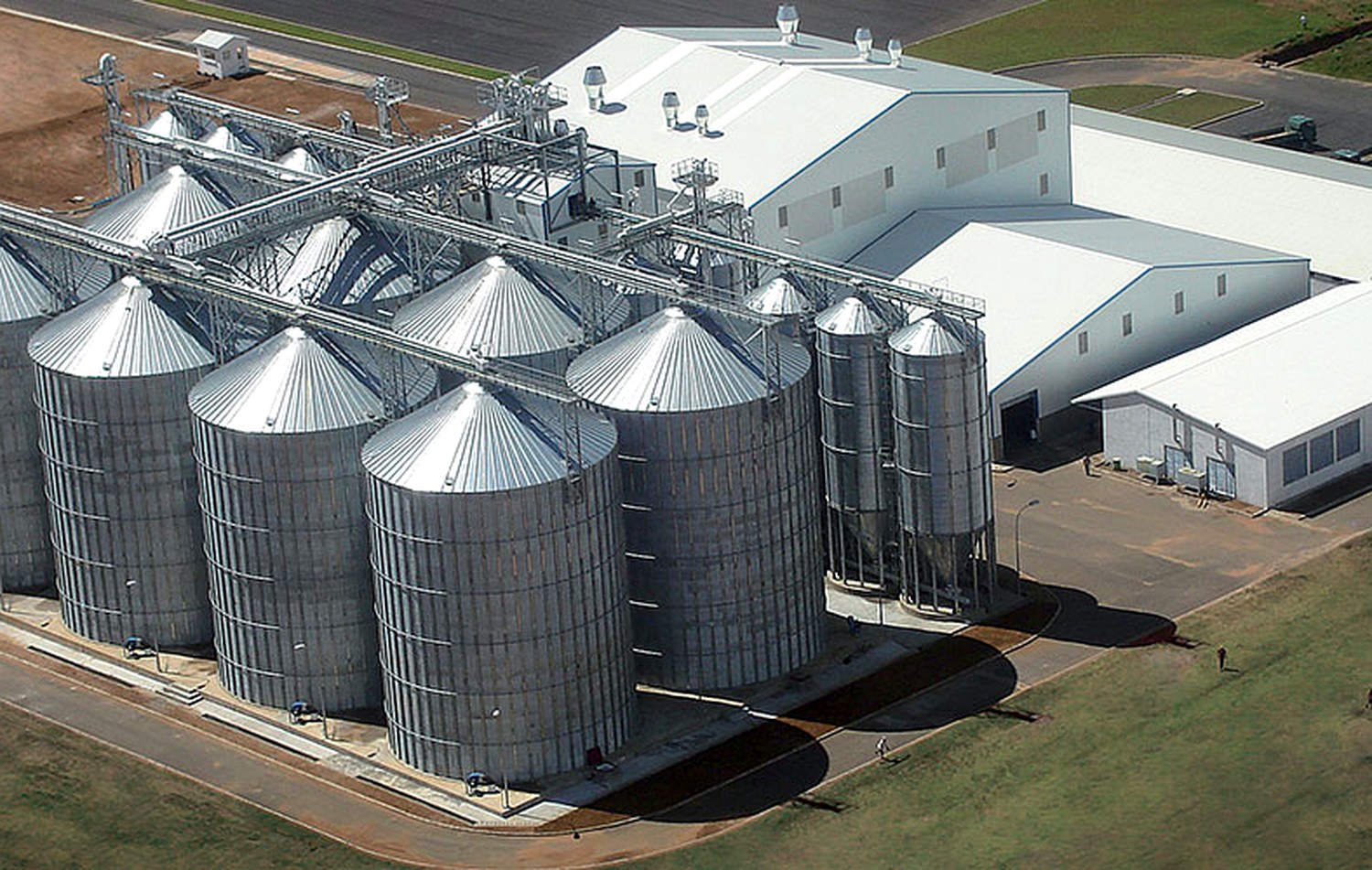
A stored grain mass is never thermally still. Warm zones and cool zones drive slow convection: air rises through the warm center, cools near the roof or wall, deposits its moisture there, and returns. Over weeks, this cycle physically moves water from the grain bulk into the cool top layer and perimeter — even when the paddy entered storage uniformly dry. That is why spoiled paddy is so often discovered in a surface crust or against a north wall, far from where any "wet spot" started. The steeper the temperature gradient — hot grain from the dryer, cold nights, steel walls — the faster the migration. Countermeasures are mechanical and informational: cool grain before binning, run equalization aeration early in the storage season, and read temperature cables weekly to catch gradients while they are still cheap to erase.
The Entomology: Insects Thrive in the Porous Bulk
Paddy's porosity gives insects oxygen, movement corridors and shelter under husks that protect them from contact insecticides. Fumigation therefore depends on gas penetration through the full porous mass — which is precisely why sealing quality decides fumigation success. Well-sealed grain silos are verified by pressure-decay testing before treatment, and recirculation systems that drive phosphine evenly through the bulk outperform passive placement. The gas-concentration-exposure principle from our fumigation systems article applies with extra force in paddy: under-dosing a porous, husk-sheltered insect population is how resistance develops.
Ventilation: Paddy's Best Friend, Used With Discipline
Because air moves through paddy easily, aeration is unusually effective — and unusually easy to waste. The disciplines that matter:
1. Move air when the air is dry. Ventilating with humid night air in the tropics pumps water into the bin; interlock fans with ambient humidity sensing.
2. Equalize early, then hold. The highest-value aeration runs are the first weeks after filling, erasing the harvest heat and moisture gradients that would otherwise self-organize into trouble.
3. Cool toward target, not to extremes. In warm climates, holding paddy uniformly at the coolest achievable stable temperature is the realistic goal; chasing refrigerated temperatures without insulation wastes energy against the silo envelope.
4. Respect the roof. Displaced air must exit; restricted roof venting pushes moisture back into the top layer where migration already concentrates it.
Paddy vs. Wheat vs. Corn: Difficulty Compared
| Property | Paddy | Wheat | Corn |
|---|---|---|---|
| Angle of repose | 37–45° (steep) | 23–38° | 30–40° |
| Bulk porosity | High (husk) | Medium | Medium |
| Intrinsic protection | Husk protects kernel | Bare caryopsis | Large kernel, germ vulnerable |
| Chief risk driver | Migration + husk-borne pests | Moisture, fungi | High respiration, mold toxins |
| Aeration response | Excellent (porous) | Good | Good |
The comparison shows why paddy practice cannot simply copy wheat practice: steeper angles change hopper and sweep demands, and porosity changes both the spoilage mechanics and the fumigation physics. Handling equipment choices — including the elevator and cleaning stages described in our bucket elevator guide — should be made with paddy's friction and dust characteristics on the table.
Storage Architecture: Matching Silo Choice to Paddy Behavior
Paddy's physics translate directly into silo selection guidance. The steep repose angle and interlocking husks make hopper geometry less forgiving than for wheat: cone and gate sizing should be specified for paddy's friction values, and discharge equipment — sweeps, gates, feeders — should be chosen for a material that bridges more readily than its sister grains. High porosity rewards investment in aeration and monitoring: fans and temperature cables simply deliver more value per dollar on paddy than on denser grains, because air moves easily and temperature anomalies propagate visibly. The husk's insect sheltering argues for sealing quality and recirculation-capable fumigation design as first-class selection criteria, not afterthoughts — a silo that cannot pass a pressure-decay test will undermine every phosphine treatment attempted inside it. And the moisture-migration mechanism elevates headspace and roof design: venting adequacy, and in tropical sites condensation control at the roof, protect the exact top layer where migration concentrates its damage. Capacity, as always, decides the bottom: thousand-ton-class paddy storage is flat-bottom territory on engineered foundations, while working and small lots live in hopper-bottom units whose gravity discharge gives clean turnover between varieties.
Regional Playbooks: Humid Tropics vs. Temperate Zones
Paddy storage strategy adapts to geography, and two regional archetypes cover most of the world's rice. The humid tropics — where most paddy grows — fight ambient humidity year-round: the aeration calendar shrinks to the driest hours of the driest days, humidity-interlocked fans replace manual judgment, sealing quality carries more weight than in any other grain application, and drying capacity at intake is the system's pacing constraint, because safe-moisture storage cannot wait for better weather. Condensation management at roofs and walls becomes an engineering line item, not a detail. Temperate zones — where rice alternates with other crops or serves niche production — get a seasonal rhythm instead: summer storage looks tropical-lite with humidity discipline, while winter brings its own hazard as cold snaps drive migration toward walls; aeration shifts to daytime-warmth hours, and the spring warm-up is planned deliberately so the bulk does not sit cold while humid air returns. Both playbooks share the core instruments — monitoring, sealing, aeration discipline, fumigation readiness — and differ mainly in the calendar and the enemy's direction. Facilities that copy a sister plant's schedule without translating it to their own climate map learn the difference one spoiled silo at a time. The translation itself is not difficult: one season of temperature-cable records reveals any facility's own migration pattern more faithfully than any imported manual, and the second year's schedule writes itself from the first year's data.
FAQ
Does the husk mean paddy needs less drying? No. The husk slows some moisture exchange at the kernel level but the bulk still equilibrates with its environment — field moisture must still come down to safe storage levels before long-term binning.
Why does my paddy spoil at the top of the silo? Classic moisture migration signature: warm interior, cool roof, convection deposits moisture at the surface. Early equalization aeration and weekly temperature reads are the direct counter.
Is paddy harder on discharge equipment than wheat? Its friction and interlocking husks make flow less forgiving — hopper angles and gate sizing should respect the steeper repose angle rather than wheat-typical values.