


Low-Temperature Grain Storage: Principles and Cooling System Design
Low-temperature storage is the quiet technology behind long-term grain quality. No chemical residues, no treated grain, no waiting periods — just a grain mass held cold enough that insects cannot breed and molds cannot advance. It sounds simple, and the principle is; the engineering is in the details. This article explains why temperature controls stored-grain outcomes, and how the cooling system, the silo selection and the monitoring layer are designed to deliver it.
The Science: Temperature Controls Everything
Stored-grain insects are creatures of temperature, and their population curve is brutally quantitative. In controlled experiments with red flour beetles on wheat, a founding population of 100 insects grew to roughly 24,000–25,000 over eight weeks at 30–35°C — the temperature band that grain freshly harvested in warm weather naturally holds. At 25°C the same population grew to about 15,000. At 20°C, growth was zero.
Three practical thresholds follow from this curve:
1. The 18°C defense line: at around 18°C (with moisture near 14.5%), most stored-grain insects stop feeding and stop breeding. This is the working target for summer cooling programs.
2. The seasonal targets: practical low-temperature storage aims to hold grain around 18–23°C through summer and below 15°C in winter — cold enough to suppress development year-round without the energy cost of refrigeration.
3. The urgency rule: grain entering storage at 30–35°C sits precisely in the fastest-breeding band, so the population clock starts on day one. Cooling a warm harvest promptly is not an optimization — it is the difference between a stable grain mass and an exponential one.
What Low Temperature Does to Pests and Mold
Cold acts on every stored-grain enemy at once. Below about 10°C, most storage insects stop moving; sustained cold at lower temperatures kills across the full life cycle, on a predictable timetable — around 12 weeks at −5°C, 8 weeks at −10°C, 4 weeks at −15°C and just 1 week at −20°C. Between the thresholds, cool grain simply cannot support the population growth that warm grain does.
Molds follow the same logic. Grain respiration, insect metabolism and mold advance are all slowed in step as temperature falls — which is why low temperature is regarded as the safest and most environmentally sound of all storage methods: the active ingredient is physics, and nothing touches the grain itself.
Cold also makes chemical treatment work better when it is needed. In a genuinely sealed, well-aerated silo, degassing after fumigation shrinks from about five days to about one — cold, sealed storage and fumigation are complements, not alternatives.
Cooling System Design: Airflow First
The cooling system is sized around one number: airflow per unit of grain, chosen from the job the fan must do.
1. Know the two airflow regimes: storage cooling uses modest airflow — roughly 0.05–0.5 cfm/bu — to move a cooling front through the grain without changing its moisture. Natural-air drying is a different duty entirely, demanding roughly 0.75–1.5 cfm/bu for weeks at a time. Fans specified for one regime run badly at the other.
2. Read the cooling timetable: the relationship between airflow and cooling time is well established — around 240 hours at 0.05 cfm/bu, 120 hours at 0.1, 24 hours at 0.5 and 12 hours at 1.0. Cooling campaigns are therefore planned in multi-day windows around favorable weather, not switched on for an afternoon.
3. Match the fan to the grain depth: deeper grain means more resistance, and the fan's static pressure must push the design airflow through the full column. Doubling the target airflow raises fan power close to exponentially — which is why the airflow target is chosen deliberately rather than generously, and why grain depth is fixed before fans are selected.
Cooling Without Condensation: The Slow-Front Method
The classical objection to cooling grain in steel silos is condensation — and the objection is valid only for systems that cool badly. Done correctly, aeration moves a cooling front gradually through the grain, and the front itself is where the moisture risk lives. The design rules keep that front under control:
1. Slow and gentle wins: low airflow over long periods moves the front evenly and lets the grain and air stay near equilibrium as they exchange — the "slow and cool" principle. Aggressive short bursts with hot, humid air do the opposite: they push moisture into the cold grain ahead of the front.
2. Run complete cycles: a cooling campaign only counts when the front has traveled the full column — from the floor inlet to the grain surface. At 0.1 cfm/bu that takes on the order of 150 hours; at 1 cfm/bu, about 15. Stopping halfway leaves a warm, moist layer stranded above cold grain — the exact stratification that produces condensation later.
3. Cool at night, hold through summer: operators use cool night air for the main campaigns, ventilate before summer to suppress the seasonal temperature rise, and seal fans off through the hot months so hot outside air cannot backflow into the now-cold grain — while venting the roof space so the headspace never becomes a radiator over cold grain.
Silo Selection for Low-Temperature Duty
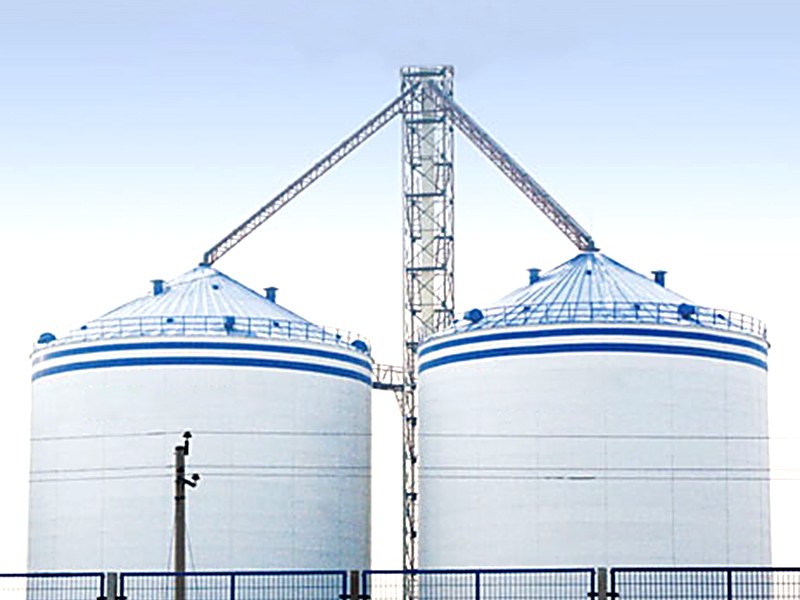
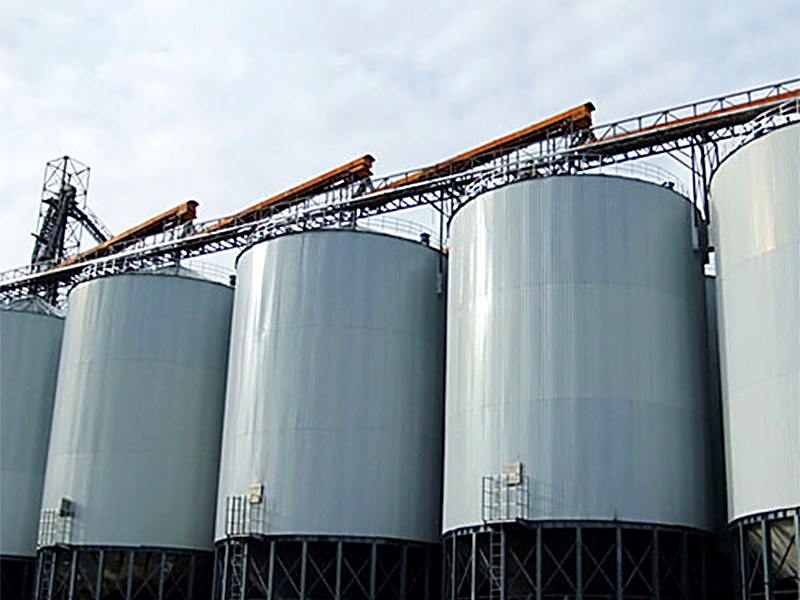
The silo structure itself is part of the cooling system. For duties that combine high airtightness with low-temperature programs, the construction options ladder up in cost and performance: insulated corrugated bolted silos first, then spiral-folded silos, then fully welded silos. Insulation limits the solar heat load on the shell; airtightness keeps humid summer air out of the intergranular spaces; and the more demanding the storage program, the further up the ladder the project goes. For the grain-storage constructions and their configurations, see our grain silo page.
Airtightness has a number attached, just as temperature does: a pressure-decay half-life (from 25 down to 12.5 mmHg) of more than 3 minutes is the commonly applied acceptance standard for a sealed store. Cold-climate projects add their own requirements — in extreme regions where ambient temperatures reach minus 40°C, low-temperature steel grades and auxiliary heating of fittings and instrumentation become part of the specification rather than an option.
Where airtight sealing is the priority — fumigation programs in particular — large prefabricated bolted constructions also enter the comparison; their sealing and insulation options are covered on our bolted steel silo page.
Monitoring: Temperature, Moisture and CO₂
Cooling systems act; monitoring tells you whether the action worked. The monitoring layer for low-temperature storage stacks three instruments:
1. Temperature cables: layered through the grain mass at regular spacing, cables localize any developing hot spot. The operational rule is comparative, not absolute: adjacent sensors reading more than about 10°F (5–6°C) apart mark an active spoilage signal, because a healthy grain mass is isothermal.
2. Humidity equilibrium: headspace and intergranular humidity readings show whether the grain is gaining or losing moisture — the early line of defense against both mold-friendly wetting and overdrying.
3. CO₂ as the early alarm: insect and mold metabolism releases carbon dioxide before any temperature signal appears. Rising CO₂ — above roughly 600 ppm and climbing — calls for a cooling campaign; sustained readings above about 1,200 ppm indicate active deterioration that must be located and handled. In practice CO₂ detects developing problems several days earlier than temperature cables alone.
Together with periodic grain sampling, these form the four-piece monitoring kit — temperature, humidity, insect activity and grain condition — that turns low-temperature storage from a static aspiration into a controlled process.
Frequently Asked Questions
What temperature should stored grain be cooled to?
The working targets are 18–23°C through summer and below 15°C in winter. At 18°C most storage insects stop feeding and breeding, and at 20°C population growth is zero — so the low twenties is a defensible summer target, with colder winter programs adding margin and killing cold-hardy stages.
Doesn't aeration cause condensation in the silo?
Only badly designed aeration does. Slow, low-airflow cooling with a complete front cycle — and fan operation limited to favorable weather windows — keeps grain and air near moisture equilibrium throughout the campaign. The condensation horror stories come from short bursts of hot, humid air that leave warm moist layers stranded over cold grain.
Is fumigation still needed with low-temperature storage?
Low temperature prevents infestations from building; it does not reliably clear an existing one. Fumigation in a genuinely sealed silo remains the tool for established infestations — and the combination works better than either alone: a sealed, well-aerated store holds fumigant concentration and degasses in about a day instead of five.
Grain keeps best when storage is engineered as one system — structure, sealing, cooling and monitoring designed together. Our company has participated in national standard development for bulk storage and manufactures steel silo systems on German silo-making equipment, and low-temperature storage duty is where that integrated engineering shows most clearly. If you are planning long-term grain storage, send us your grain type, climate profile and storage duration targets, and our engineering team will propose the structure, cooling and monitoring configuration the duty requires.