


Cement Strength vs Storage Time: Why Sealing Matters
Every ton of cement begins losing strength the day it leaves the mill. Not fast, and not fatally — but measurably, and the rate depends almost entirely on one thing: how much moisture the cement meets before it meets the mixer. For plant operators and terminal managers, "how long can we stock this cement" is therefore the wrong question standing alone. The right question is: what environment are we storing it in? This article explains the chemistry behind strength loss, shows what the numbers actually say, and connects both to the silo engineering that decides them.
The Science: Pre-Hydration, Slow and Invisible
The villain is a process called pre-hydration — cement hydrating partially, in storage, without ever being mixed. The mechanism starts with the free lime in cement: it is the most moisture-hungry component, and it reacts first with whatever water vapor is available, forming hydration products that build a thin shell around the clinker particles — the very particles that are supposed to react later, in the concrete, where their strength counts. Once wrapped in this pre-formed shell, each particle reacts more slowly and less completely when real mixing finally comes. The measurable consequences are threefold: compressive strength declines, the powder's fineness readings shift, and setting times stretch out.
None of this is visible from outside. A silo of pre-hydrating cement looks exactly like a silo of fresh cement — which is why the controlling variables are engineering variables, not inspection schedules.
What the Numbers Say
Documented storage trials under open and humid conditions quantify the decline:
| Storage period (open / humid conditions) | Relative strength retained |
|---|---|
| 2 weeks | Approximately 97–99% |
| 1 month | Approximately 93–97% |
| 3 months | Approximately 85–92% |
| 6 months | Approximately 75–85% |
Alongside strength, fineness values typically drop by a small number of Blaine units over the same periods, and setting times extend — on the order of ten minutes to two hours depending on severity. Two caveats belong with the table. First, these figures describe unfavorable storage: cement exposed to open, humid air. Sealed storage slows the same curve dramatically. Second, quality control has a simple freshness test of its own: loss on ignition below roughly one percent indicates fresh, un-pre-hydrated cement; a rising LOI is water that has already gone somewhere.
Why Sealing Matters More Than Time
The table's message is that moisture exposure — not time itself — sets the decay rate. The same month of storage in a dry, sealed silo and in a vented, humid one produces completely different cement. Moisture reaches stored cement through three doors: humid air drawn in with conveying air during filling; air exchange through roof openings as the silo breathes with daily temperature cycles; and condensation — warm cement entering a cool shell, or humid air hitting a cold wall, deposits water directly onto the material. Hot cement straight from the mill magnifies every one of these paths, which is why entry temperature discipline (keeping cement below roughly 65°C before storage) is the first operational rule of quality storage: hot cement plus a humid silo is the textbook recipe for caking and pre-hydration together.
How Silo Design Delivers Sealed Storage
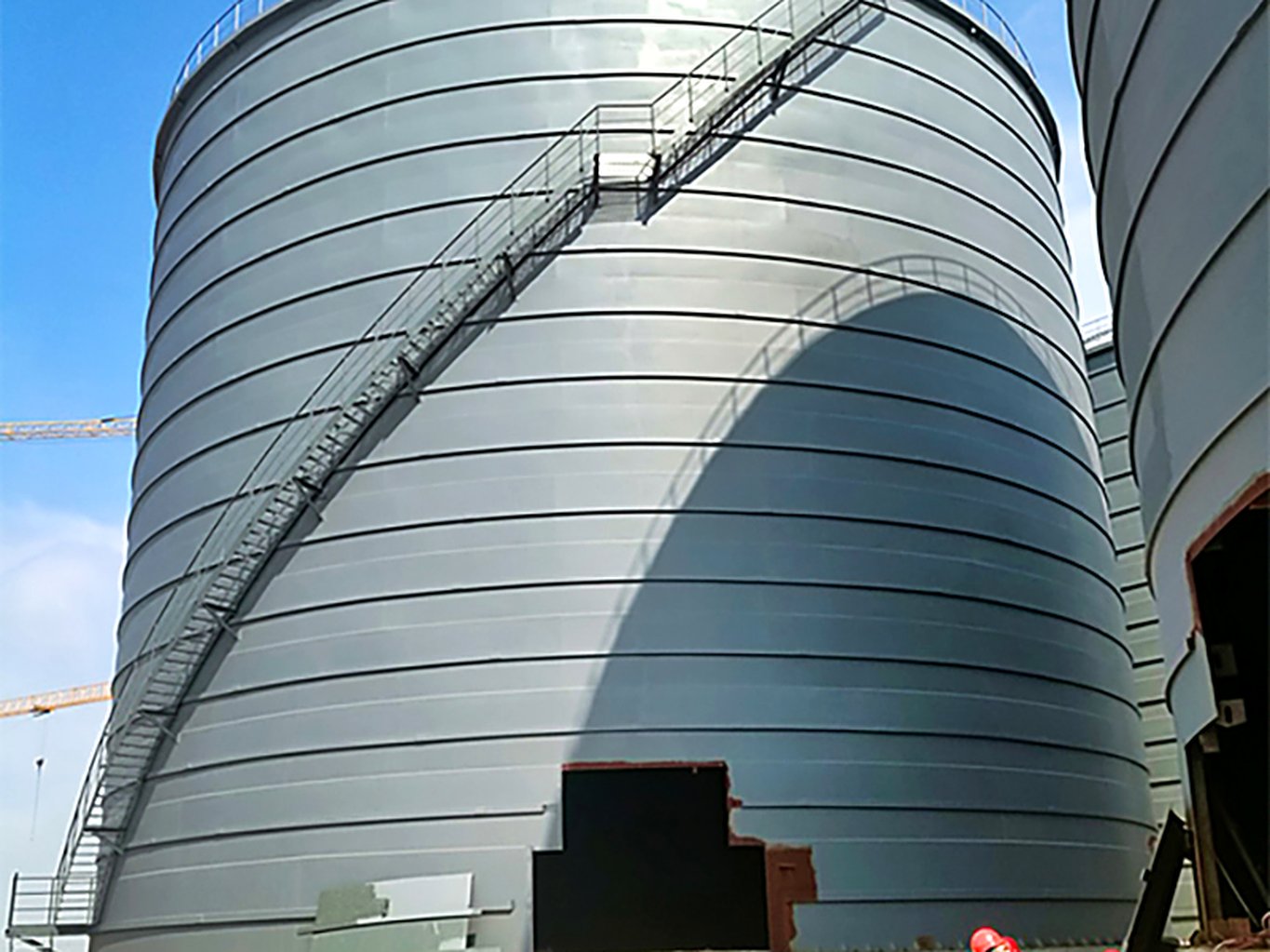
This is where structure earns its specification. A welded steel silo with properly engineered seams and fittings offers a continuous envelope that bolted construction matches only with effort — every bolted joint is a gasket dependency, every gasket an aging part. On top of the shell, four details complete the sealed-storage package:
1. The roof as a system: a sealed roof plate, with the vent filter matched to a pressure-relief valve as a working pair — filling displaces air through the filter, and the relief valve protects the shell in both directions. One without the other eventually deforms something.
2. Dry air where air must enter: fluidization and conveying air prepared to be dry, so that the air meant to move cement never becomes the moisture that ruins it.
3. Level measurement that keeps the roof closed: continuous level sensing with redundant high-level switches means operations run without opening inspection ports; every opened port is a humidity event.
4. Discharge that stays sealed: the aeration discharge system and its gate valves maintain the envelope at the bottom, where humid air would otherwise rise into the column. The welded silo and cement silo product lines are built around this package.

From Mill to Silo: Where Moisture Enters
Tracing the paths water vapor takes to reach stored cement turns the theory into a checklist, and every item on it is a specifiable engineering decision:
1. Conveying air: pneumatic transfer moves hundreds of cubic meters of ambient air per ton of cement — air drawn on a humid day carries that day's humidity straight into the silo headspace. Dry-air preparation or minimum-humidity conveying schedules cut this path.
2. Breathing: a silo inhales and exhales with every fill and discharge cycle and with daily temperature swings; unfiltered, unconditioned breathing exchanges the dry interior atmosphere for whatever is outside. Filter-and-valve roof design makes the exchange one-way and clean.
3. Condensation on the shell: the sneakiest path — warm cement or a warm day puts moisture-laden air against a cool shell wall at night, and the wall collects dew directly above the cement column. Insulation and entry-temperature discipline close this door.
4. Opened ports and inspection hatches: every opened cover admits a slug of uncontrolled air. Sealed level measurement exists precisely so that routine operation never needs them.
Practical Storage Discipline
Engineering makes sealed storage possible; management makes it real. First-in, first-out stock rotation prevents the quiet accumulation of old cement at the silo bottom — the material that leaves last always ages longest. Entry-temperature control at reception keeps hot cement out of contact with shell condensation. And a periodic LOI check on dispatched material turns the freshness test into a routine gauge of the whole system: if LOI stays low, the seal is doing its work; if it drifts, somewhere a door is open.
Frequently Asked Questions
Is three-month-old cement still usable?
Depends entirely on where it spent the three months. In a properly sealed, dry silo it will perform close to fresh; in open or humid storage it may retain only about 85–92% of its strength. Test rather than guess: loss on ignition below roughly one percent is the practical freshness indicator.
How can I tell if stored cement has absorbed moisture?
By laboratory loss-on-ignition and setting-time tests, and in advanced cases by physical caking. Visual inspection of the silo tells you almost nothing — pre-hydration is invisible until it is expensive.
Does a sealed silo really slow strength loss?
Yes — sealing attacks the cause rather than the symptom. Pre-hydration needs water vapor; a welded, sealed envelope with dry service air deprives it of that input, flattening the decay curve that open storage walks down month by month.
Cement quality is decided twice — once at the mill, and once in the silo that keeps it. Our company builds steel silo systems on German silo-making equipment, with fine-powder sealing, aeration and environmental protection as core engineering territory. Bring us your cement type, climate and stock-turn pattern, and the storage package will be specified to protect the strength you paid for.